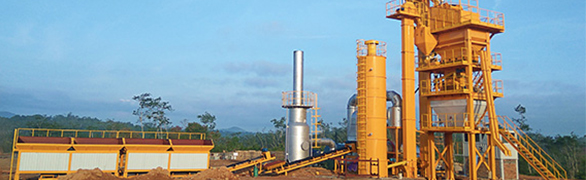
Key Considerations for Customers Purchasing Mobile Asphalt Plants
Mobile asphalt plants are primarily designed for clients involved in road maintenance, municipal emergency repairs, and projects requiring operations at multiple, dispersed locations—a procurement context that differs from that of stationary asphalt plants. When selecting a plant, customers look beyond the price tag, evaluating the equipment based on several comprehensive criteria: how quickly it can be put into operation, the stability of its output, the ease of relocating between sites, and its long-term cost-effectiveness. In short, customers focus on the following key aspects:
Production Capacity and Mixing Quality: Meeting Project Material Requirements
Production capacity is the primary metric for customers. By assessing daily paving volumes and project timelines, they determine whether a plant’s rated output can handle peak demand, ensuring that insufficient capacity does not hinder construction progress. Furthermore, because the quality of the asphalt mixture directly determines whether a road passes inspection, customers place great importance on the precision of the weighing/metering system, the accuracy of aggregate-to-asphalt ratios, the stability of discharge temperatures, and the uniformity of the mix.
Many customers distinguish between batch (intermittent) and continuous-type plants. For high-grade road construction or projects involving modified asphalt—where precise mix ratios are critical—customers tend to favor mobile batch plants. Conversely, for smaller maintenance projects or operations requiring a continuous supply of material, they may opt for mobile continuous-mixing plants. Customers also look for equipment that supports specialized processes, such as warm-mix asphalt production or the use of reclaimed asphalt pavement (RAP), to accommodate diverse construction requirements.
Relocation and Assembly/Disassembly Capabilities: The Core Value of Mobile Plants
The primary motivation for choosing a mobile asphalt plant is the need for construction across multiple locations. Clients prioritize a modular, trailer-mounted design—specifically, whether the plant eliminates the need for complex foundation work, offers a simple assembly and disassembly process, ensures efficient relocation, and complies with local regulations regarding width, height, and weight limits for road transport.
Frequent relocation can lead to loose piping or misaligned sensors; therefore, clients also scrutinize structural integrity, the reliability of locking mechanisms and connections, and the complexity of post-relocation commissioning. The goal is to resume production quickly, thereby minimizing downtime costs during transitions.
Energy Consumption and Operating Costs: Long-Term Economic Viability
Many clients focus solely on the initial purchase price, only to later face challenges related to fuel consumption, electricity usage, and the cost of spare parts. During the procurement phase, clients carefully evaluate fuel consumption per ton of asphalt mixture and the total installed power capacity. They often prioritize drying drums with high heat-exchange efficiency to reduce fuel expenditures.
Additionally, clients examine the list of wear parts—such as liner plates, mixing blades, filter bags, burner components, and sensors—to assess the availability, compatibility, and cost of replacements. This allows them to evaluate the total lifecycle cost of the equipment rather than just the base price. Fuel versatility is another key consideration; clients must ensure the equipment can operate on locally available fuels, such as diesel, heavy oil, or natural gas.
Environmental Compliance: Meeting Local Regulatory Standards
Whether for domestic or international projects, environmental compliance is a mandatory threshold. Clients verify whether the dust collection, odor control, and noise reduction systems meet local emission standards and are sufficient to secure construction permits. For international projects, clients also consider specific local environmental regulations and the necessary equipment certifications. Failure to meet environmental standards can result in a mandatory work stoppage and significant financial losses; consequently, compliance is a "make-or-break" criterion in the selection process.
Configuration, Control Systems, and Ease of Operation: User-Friendliness
Operators of mobile plants often move from project to project, resulting in high personnel turnover. Clients are concerned with the level of intelligence in the control system, the simplicity and intuitiveness of the user interface, and the comprehensiveness of data logging functions—including support for recipe storage and the export of production reports to facilitate quality traceability.
Clients also select optional equipment based on their specific requirements, such as asphalt tanks, drum decanting units, powder supply systems, recycling systems, or remote monitoring capabilities. Furthermore, they prioritize safety features—ensuring the presence of emergency stop mechanisms, high-temperature protection, and fire prevention measures—to guarantee safety during field operations.
Commercial Terms, Pricing, and Delivery: Budgeting and Risk Management
Clients require a detailed breakdown of the total equipment cost—separating the price of the main unit, optional accessories, packaging, ocean freight, installation guidance, and training—to avoid ambiguous quotes or unexpected additional charges later on. In the contract, it is crucial to clearly define delivery timelines, acceptance criteria, payment milestones, as well as the duration and scope of the warranty, distinguishing between services provided free of charge and those that are billable. For overseas clients, specific attention must be paid to packaging solutions, customs clearance documentation, and shipping logistics to mitigate risks related to transport and import procedures.
After-Sales Support, Training, and Spare Parts: Ensuring Rapid Issue Resolution
Field construction sites often present challenging conditions; if equipment breaks down, the entire paving crew and roller fleet may be forced to stand idle, resulting in losses that far exceed the cost of the spare parts themselves. Clients prioritize the speed of after-sales response—specifically the timeliness of remote technical support, the turnaround time for on-site engineer visits, and the efficiency of spare parts dispatch.
Furthermore, clients expect comprehensive operation manuals and maintenance documentation, along with training on assembly/disassembly, calibration, and routine upkeep, enabling their own staff to perform basic troubleshooting. A robust inventory of spare parts and a reliable after-sales support system are critical factors that influence a client’s final purchasing decision.
Conclusion
In summary, when a client chooses a mobile asphalt plant, they are essentially selecting a complete mixing solution that is adaptable to multiple construction sites, offers consistent quality, ensures regulatory compliance, and is backed by dependable after-sales support. Production capacity and quality serve as the foundation; ease of relocation is a key advantage; energy consumption and spare parts availability dictate long-term costs; and environmental compliance is a non-negotiable baseline. Ultimately, it is the combination of sound commercial terms and reliable after-sales support that gives clients the confidence to place an order.